Wednesday, January 23, 2013

They’re our mountains, after all

Adhithya Krishnamachari

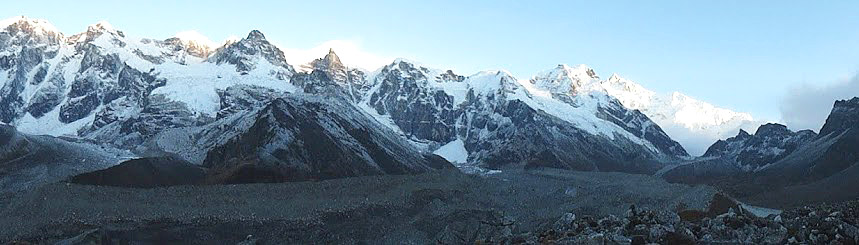
My first Goecha La trek has been my most memorable trek till date, with the Himalaya at their astounding best and Kanchenjunga, the icing on the cake! The entire trek took us from September 29 to October 8, 2012.

With the strong motivation to contribute to the conservation of this untouched beauty, my team and I signed up for the Green Hiker campaign. Under the campaign, we took the following initiatives on our trek:

1) Our first mantra was "have legs, will walk". During the eight days it took from the base camp at Yuksom to the summit at Goecha La, and then back to Yuksom, we only walked. Not only was it a thrilling experience to get up close and personal with nature, but it was also reassuring to know that we weren't causing any air pollution.

2) From Day 1, we carried out a cleanliness drive throughout the trek, collecting any garbage found on the way and stuffing it into our daypacks. The majority of this waste was left behind by trekkers and other tourists who passed by that route. To make the drive more efficient, I assigned each team member with one kind of garbage to collect, that is, one would pick up plastic plates and glasses, while another would pick up food wrappers and so on. The garbage we collected every day was dumped into the bin of the nearest trekker's hut or a makeshift dustbin. We ensured that no plastic waste was left behind.

3) We reused water bottles that we collected on the way. This way, the use of plastic was curtailed as we no longer purchased or used new plastic bottles.

4) Before stepping into a stream, we made sure to remove our footwear and bags, especially since the stream water is the main water source not only for trekkers but also local people and animals.

5) We sought accommodation only in home stays and trekker huts which not only minimised resource consumption but also benefitted the local economy. None of these trekker huts had electricity; nevertheless, they were great places to bond with fellow trekkers after a long day's walk.

6) In places where trekker huts were not available, we set up tents at an optimum distance from water bodies to avoid any kind of disturbance. We did not even camp at Samiti Lake (one of the most scenic places in the trek) to help preserve its purity and beauty.

7) Majority of the trekker huts had decent toilet facilities which consisted of pits dug deep into the ground. In places without toilet facilities we choose to dig small pits and covered the same with mud once done. For this we chose spots away from water bodies to prevent pollution.

8) We used only headlamps and torches for light and lit no campfires to avoid air pollution or the danger of accidental forest fires.

9) Our food was cooked on traditional kerosene stoves and our tour operator ensured that minimum forest resources were utilised. In addition, we carried packed lunches and protein bars to prevent unnecesary consumption of fuel for cooking.

We felt a lot of emotions during our trek. There was joy on reaching Goecha La summit after 10 grueling days of climbing, sadness on realising that the trek was drawing to a close, frustration at missing out on some gorgeous views due to fog. But more importantly, we felt a sense of responsibility towards the Himalaya - to protect, to conserve and to respect. More than the trekking, the fact that we did our bit to protect these majestic mountains gives me utmost happiness and motivates me to trek again.
I’d like to thank the Green Hiker team for starting such a wonderful initiative, my trek mates who worked together as a team and our tour operator for ensuring that we trekked responsibly. All in all, I’ve had a great experience as a green hiker and I hope to implement these sustainable measures in my future treks as well.


Adhithya Krishnamachari is a 24-yr old IT professional at TCS, Mumbai. Besides being a techie, he is passionate about trekking and is a part-time trek leader with a Mumbai-based travel start-up. He can be contacted at adhithya2007@gmail.com

Monday, November 12, 2012

Mountain people united

Mussourie. A place drenched in history, culture, natural beauty and stories young and old, that can enthrall even the most blaśe.

This is the buzzing, yet quiet hill station that presents writers, thinkers, mountaineers, artists, conservationists and everyone else who has something to do with the mountains, a platform to meet. To converse. To share. And to experience.

All this through the Mussourie Writers Mountain Festival (http://www.mussooriewriters.com/upcoming-events/a-mountain-festival-2012/). This year, which happened to be its fifth mile stone was packed with action! From short films to a Himalayan food festival, from mountain poetry recitation by Gulzar sahib himself to presentations on exciting (and life threatening) ascents to towering peaks, from photography exhibitions to musical performances by Rekha Bhardwaj and the Tetseo Sisters, from a presentation on petroglyphs to travel writing.

Even more serious subjects claimed their place. There were speakers on 'ecotourism and environmental issues in Spiti', 'politics of climbing in the Himalaya', 'wildlife in the Eastern Himalaya' and 'people, and wetlands and biodiversity in the Himalayan high altitudes (the last two from WWF-India).
Green Hiker poster on a notice board at Woodstock School
© Indrani Bordolai

I attended the festival in the capacity of a participant and a speaker on the Green Hiker Campaign. So pleasantly surprised I was when while sauntering down the corridors of Woodstock School (where the fest took place, partly), I came face to face with Green Hiker posters in classrooms and common notice boards! All thanks to Woodstock’s HANIFL Centre for Outdoor Education, a new-found friend of the campaign and the second venue for the festival. Moreover, I started interacting with fellow participants, only to find out that they already knew about the campaign and regularly followed it! Aaah! The comfort of like-minded company!
 
Speaking on Green Hiker © Rajarshi Chakraborty


Being the second last speaker at the festival, the message of Green Hiker was left behind loud and ringing. I felt I was talking to an audience of responsible travellers which was eager to learn more about the initiatives and how they could get involved. Very heartening I must say!

Hopefully, the campaign will have new stories (we pray for success) to tell at the festival next year. Stories that will mingle with others that the wind carries around those green hills. Those green hills where Woodstock School happily stands.

Thursday, September 27, 2012

Can tourism in Northeast India take off on a sustainable note?

As we entered the conference room, conversations in Axomiya and Garo buzzed in the air. Taking our seats we looked around and found an interesting assortment of officials from the North East Council (NEC), Ministry of Tourism (MoT), Ministry of Development of North Eastern Region (DoNER) and Transport department. Also present were the president of the Association of Tour Operators of North East India (ATONEI), president of the Indian Association of Tour Operators (IATO) and other tourism stakeholders. Journalists sat with their pens ready, as the arrival of the Hon’ble Minister of Transport and Tourism, Government of Assam was eagerly awaited.

Finally, the workshop on ‘Making North East Tourism Ready’ began. Organised by the Confederation of Indian Industry (CII) in collaboration with DoNER, ATONEI and NEC, the workshop was chiefly aimed at discussing an Integrated Master Plan prepared by Tata Consultancy Services (TCS) for NEC, for strengthening tourism circuits in the North East Region (NER). The technical sessions highlighted the tourism potential of the NER, the importance of developing infrastructure for promoting tourism, destination promotion, skill development and capacity building.

Experts spoke about the impediments to tourism in the NER, namely lack of infrastructure, skilled manpower, a common tourism master plan and most importantly, marketing! The master plan drew attention to different factors related to tourism. It talked of improving air and rail connectivity for tourists, of utilising intangible resources like local art and craft to draw tourists (something called ‘cultural tourism’), of specific destinations of tourism potential (lakes, wildlife reserves and more) in the 8 north-eastern states of Arunachal Pradesh, Assam, Manipur, Meghalaya, Mizoram, Nagaland, Sikkim and Tripura. It also harped on the various management-related issues to be faced during the implementation of the master plan.

I listened carefully in anticipation of another issue that loomed large and formidable in the background. But it never came. Had nobody really thought about it? Or had it simply been brushed under the ‘development’ carpet?

What about the environmental impact??? Hello??? Had that been taken into account at all? Everybody kept singing praises of the Northeast being the "unexplored paradise", about how “Nature and Culture” are the biggest “Unique ‘Selling’ Proposition” (USP) of the NER. Well, how do you expect tourism to thrive or even exist, if you don’t safeguard your first USP?? Other disturbing thoughts shot through my head. ‘Selling’? Was all that unique biodiversity and ecosystem really on sale? But before I went all philanthropic, I stopped and dragged my whirring mind back to hard facts.

This is the reality of tourism development. On one hand, it offers employment opportunities to local people, sound infrastructure and amenities, and recognition of local culture and traditions. And perhaps, this is what the Northeast needs. But not at the expense of its natural heritage! A balance is imperative. And for this, the long hike needs to start on the right foot.

The TCS project team which prepared the master plan claimed in passing that the plan had been made in consultation with concerned “tourism stakeholders.” It is left to wonder who these ‘stakeholders’ are. It was also stated that they have “tried to keep communities as the central focus.” If that was so, then where were the environmental issues, considering that the people of the Northeast are deeply respectful and protective of their natural treasures? Tourism cannot function in a vacuum, without the engagement of the local communities - the principal stakeholders of tourism, anywhere! They cannot be reduced to the status of a “tourism attraction”, along with “nature, wildlife, biodiversity, culture, heritage, religious and intangible resources…” as the master plan puts it.

I sat and watched tour operators being pleaded with to bring their businesses to the NER, for the tourism industry to resort to “aggressive marketing” as they called it. But then what about standards of sustainable tourism? Had any been set before the bandwagon arrived? How could an open invitation be sent out before their house was in order? For example, was there an effective waste management plan in place? What about measuring the tourism carrying capacity of each state and tourist destination? Did the local people really want big numbers? During the workshop, there was a proclaimed preference for “quality tourism” rather than numbers, but does quality have to mean the provision of air conditioned comfort, showers and flush toilets in biodiversity hotspots? It’s like enabling your tourist to view a rhinoceros from an air-conditioned elephant back! Is this truly ‘experiential tourism’?

The only two organisations at the workshop with this concern were the Ecotourism Society of India (ESOI) and WWF-India. Clearly outnumbered, we raised questions and elucidated issues that could not be ignored. Together, we recommended the establishment of Green Tourism Standards, an Environment Impact Assessment (EIA) of every area in the NER being developed for tourism before the implementation of the master plan, close collaborations and consultation with local and other conservation NGOs with a scientific understanding of the eco-region – all to help tourism in the Northeast make a sustainable start. And to stay that way.

We walked out of the conference room, in nervous anticipation of the future of the biodiversity and culturally-rich Northeast, with tourism gradually slipping into the driver’s seat.

Wouldn’t it be wonderful if the unexplored Northeast India on the threshold of tourism development turned out to be a pioneer of responsible tourism in the country right from its inception?


Voices from the Northeast:-

“It is great to know that there are plans to introduce large-scale tourism in the Northeast. While this will benefit the region immensely I think this should be implemented gradually. We take great pride in our culture, our land with its lush green cover, crystal-clear lakes and cascading waterfalls. Caring for it is second nature to us. There are local myths and lores attached to many places; stories that people revere. Visitors to the Northeastern states should be sensitized to this fact and demonstrate equal respect for the environment around. It breaks my heart when I see the Umiam Lake in Shillong littered with the remains of a weekend picnic revelry by a tourist party! Also, one must collaborate with the locals in order to make tourism a sustainable and responsible exercise.”

Janusa Barbara Sangma
Shillong, Meghalaya

“When you think of opening up one of the planet’s mega biodiversity hot spots to tourism, the key operating principle to bear in mind is that of ‘balance’- a balance that will enable the fulfillment of human needs along with the protection of nature. All our lives: social, cultural and economic are cocooned within the ecological circle, if we are foolish enough to tamper with this outer all encompassing circle, it will be at our own peril!

Those inscrutable dark forests and pristine blue rivers, all abounding with life are the wealth of the NE and we cannot ravage it for myopic gains. We have to find a way to keep our natural capital intact and reap dividends from the interest.”

Mita Nangia Goswami
Assam

PHOTO CREDITS:
1. Gombu-Latso, Arunachal © Pijush K. Dutta
2. Satyr Tragopan, Sikkim © Basant Sharma
3. Local communities in Sikkim © Basant Sharma
4. Cyananthus lobatus © Basant Sharma

Monday, September 3, 2012

Story of a Green Hiker…

“I didn’t want to be just another mountaineer who climbed Mount Everest, got his glory and got out of there.”

  
Half Nepalese-half Belgian, standing sturdy at 6 feet something, Dawa Steven Sherpa is a hard core mountaineer and trekker, but with one thing that sets him apart from the many others scrambling to summit indomitable peaks. He is moving mountains to keep his mountains clean.

Born in the Sherpa community and brought up amongst mountaineers, Dawa was destined to be a climber himself. His father, Ang Tshering Sherpa, has been the president of the Nepal Mountaineering Association and is currently the Immediate Past President (IPP) of the association. Both father and son run an expedition company called Asian Trekking.

Dawa reached the summit of Mount Everest in 2007, where seeing the cold, distrustful atmosphere and attitude amongst fellow travelers, he established a ‘base camp bakery’ so that hikers could meet, get friendly, and figuratively, break the ice. It was on this expedition, that he witnessed large amounts of garbage on the mountains, proving right National Geographic’s statement that Mt. Everest had become the “world’s highest garbage dump.” That is when he made up his mind to do something about it.

To tackle the problem of human waste, the young climber started importing Restop toilet bags from an American company called American Innotech (http://www.whennaturecalls.com/) which are till date, distributed free of cost to his clients and Sherpas. Moreover, Dawa sells these bags to other expeditions at cost price to encourage their use. Now, many
expeditions are bringing their own toilet bags, so the concept has proven to be a success. Through an initiative called Eco Everest Expedition, Dawa is using the resources and manpower available on the expeditions (organised as part of his business) to clean up during the expedition period (April and May). A portion of his client’s fees goes into implementing this clean up. Under this, he is also running ‘Cash for Trash’, where he offers Rs.100 for ever kilogram of trash carried back down by travelers/guides. So far, he has managed to bring down 14,259kg of trash!!

Dawa first collects the garbage – tin, aluminium, cloth, paper, wood and plastic; toxic stuff like batteries; helicopter debris (there have been four helicopter crashes) and biodegradable waste. This then goes to the Sagarmatha Pollution Control Committee (SPCC), one of the key founders of which was WWF-Nepal. He keeps the tin and aluminium in storage till he figures out what to do with them.

A garbage disposal system has been in place since the 1990s, where the Government of Nepal made it mandatory for visitors to bring back their garbage after a trek. However, this only ensured that new garbage is not dumped on the mountain, while the garbage littered before, remained un-collected since no one was accountable for it. Dawa has been collecting this trash from Mount Everest since 2008, and with combined efforts the garbage situation is getting better.

When asked if he finds it tough to stop people from littering, he coolly replies, “It’s easier for me to tell a guide or porter in Nepal to not litter because tourism is the mainstay of the country. They can make that connection between their action and the consequences of it.”

Realising the potential threat of climate change in Nepal, in the form of melting glaciers, higher incidences of Glacial Lake Outburst Flood (GLOF), fall in water supply, crop failure and changes in weather patterns, Dawa took a crash course in climate change from ICIMOD to develop a better understanding of the issue. “The problems we face now were never faced by my grandfather,” he says with a grimace.

But in order to organise his initiatives and send out the message in a bigger way, he needed the support of important persons and big organisations, with a similar mission.

This is when he got Apa Sherpa, the famous mountaineer and world record holder of climbing Mount Everest 21 times, on board. Apa had been a victim of a GLOF which wiped out his whole village, leaving him nothing but a blanket. In addition, Dawa got in touch with Nepali youth clubs like the Sherpa Students Network and other university students, confident in the power of young people to rally and make a difference to the society and environment around them. He organised the resources to support them and started a national campaign, where they managed to collect enough petitions to get the government to actually recognise these environmental problems. This culminated into a historical cabinet meeting at the Everest base camp where climate negotiations were held and issues discussed.

Besides the environment, Dawa has gotten involved with the human aspect of the situation. There are local communities in Nepal that are solely dependent on agriculture for sustenance, which if adversely affected would leave the people impoverished and helpless. He wanted to learn more about these communities so he could help them. According to him, most mountain communities know exactly what they need to survive on; they can perceive changes in their environment and sometimes may even know how to address them. However, they lack technical know-how, awareness about climate change, finances and able leadership.

Hence, Dawa co-founded the non-profit Himalayan Climate Initiative (HCI) with like-minded people. “Our work focuses on protecting the mountain environment and better the lives of the mountain people. We have already started a few initiatives, including the banning and replacement of plastic bags, setting up climate change response centres to educate and build resilience amongst the vulnerable communities, and working with the government and private sector to build a Zero Carbon economy, and creating ‘green jobs’.”

Part of this was the Great Himalayan Trail - the introductory project to highlight the vulnerability of local communities to climate change. This trail goes from the easternmost point of the Himalaya to the western most and vice versa. For HCI, Dawa and his team including Apa Sherpa decided to walk the whole length of Nepal to talk to the local communities. Two years of their lives revolved around planning for this journey, a journey that they finished in 99 days, having travelled 1,555km!

On the issue of tourism being a possible threat to the Himalayan ecology, Dawa is of the opinion that, “Tourism is the second highest revenue generator for Nepal. It is the best bet for these communities who have some amazing culture…but not tourism at the cost of the environment…tourism has to be sustainable.” He strongly emphasises, “The Himalaya is undoubtedly the most beautiful landscape in the world and undoubtedly, also the most fragile.”
Dawa sure has his hands full. And it all started with his love for the mountains that he calls home.

For any information or queries, Dawa Steven Sherpa can be contacted at dawasteven@gmail.com

Thursday, May 3, 2012

The Himalaya – through the lens

What is your vision for the future? Not just your future but also the future of the generations that will come after you. It is a well known fact that one of the key factors that determine the success of individuals, as well as, groups is their ability to have an insight into the future. The choices we make and the decisions we take in the present are based on our perception of the future.

I was traveling to the mountains for a break, hoping for peaceful surroundings, lush green forests and the company of the humbling Himalaya. But in my travels I was shocked to encounter traffic jams, crowds of people and a sea of buildings. I realized that my vision of life in the mountains was not entirely true.

My experiences and thoughts are reflected in the film below:

http://www.youtube.com/watch?v=LE1vt3hV7Zo

Off late short term vision and short term growth is being given priority over a longer view of things. The desire to see immediate results and quick profits is slowly creating an imbalance in our lives and our environment. The question that we are left to deal with at this point in time is: Where do we go from here? - as individuals and as a society?


Nitin Das is an independent filmmaker based out of New Delhi. He has made a wide range of award winning films on various social themes. For more of Nitin's work visit his web-site: http://www.filmkaar.com/


Wednesday, January 25, 2012

Chugging the Green Hiker way…


Ragini Letitia Singh, WWF-India

As the train pulled away from the station, I snuggled into my corner with a book to keep me company and to disassociate for a moment from my awry thoughts. This was not a routine journey to a holiday destination with some fun to look forward to. There was work to be done, important work and I wondered if I was up to it.

My gaze strayed to every passenger sitting, snoring, reading, munching and chatting around me. And then it happened! A hand crumpled an empty packet of chips and out of the window it went! I was livid. WHY? Why do they have to do that? There are dustbins on the train, waiting to be used. Or a simple makeshift dustbin could be devised by a few berth occupants, where all the trash could be collected.

Solutions are many, but actions only a few.

One thought brought comfort. At least these people had opted to travel by train which is a far cleaner and eco-friendly mode of travelling than by road or air, since it has reduced amounts of harmful emissions. I remembered reading bits from the Interim report on ‘Low Carbon Strategies for Inclusive Growth’ by the Planning Commission, Government of India, during the course of my work. It said, “In contrast (to the aviation sector), rail contributes only five per cent of the transport sector emissions while supporting about 40 per cent of freight activity and 12 per cent of passenger activity. Therefore, reducing Greenhouse Gas (GHG) emissions from the transport sector would broadly require a shift away from road and air towards rail and water, in addition to improving efficiencies of individual modes.”

The train raced towards my destination – Pathankot in Himachal Pradesh, from where a bus to Chamba and then another to Bharmour would wind me up at the base of the famous Manimahesh trekking route. Thousands of Hindu pilgrims ascend the difficult mountains here every year to reach Manimahesh Lake at an altitude of 4,088 masl, to eventually bathe in its holy waters. What they leave behind is plastic litter, left-over food, wrappers, fruits, offerings, sheep and goat carcasses, clothes, noise pollution, and tons of human excreta along the path and in and around the lake.

This is why I was here. Representing WWF-India, I had come to spread awareness amongst tourists and pilgrims on the importance of keeping the lake and the trekking route clean, with the help of my teammates from the WWF Himachal Field Office. I had come to tell them about the Green Hiker campaign, which simply put, encourages a more ‘responsible’ kind of tourism.

Our basic objective was to protect the Himalaya because our most important rivers - the Ganges, Brahmaputra, Indus and the Yangtze, are all born here. It is also here that we find pristine wetlands, mostly fed by snow and glacial melt. These are some of the last sources of freshwater on Earth on which depended the massive human population in Central and South Asia, several species of migratory birds, fish and mammals. Any change to the dynamics of these wetlands could reach all the way downstream impacting fish populations, biodiversity, agriculture, river infrastructure, flood cycles and communities. This is why it was so crucial to leave this fragile environment clean and undamaged.

The movement of the train set off a chain of thoughts. Every year, a huge number of travelers visit the Himalayas through the railway network. Unfortunately, a large percentage of them are responsible for littering and solid waste management problems. Why don’t train travelers do something about it? Surely they could contribute by keeping the railway tracks and their surrounding environment clean. The simplest measure to adopt would be to use the dustbins available in the train or to collect garbage and leftover food in a bag to dispose in a dustbin later. This small act could actually go a long way in keeping our pathways to the pure and pristine mountains litter-free and pure.

Suddenly there was a pleasant whiff of hot food, instantly enticing my appetite. The pantry staff arrived with trays. Once my tray was before me, it had all my attention. As I chewed fervently, I wondered how the staff always knew when to serve at the right time. When they came to clear my tray, I handed back the unused napkin, plastic spoon and sachets so they could be used next time by someone else. They looked surprised and probably thought, “What a strange thing to do!”

I received their look of surprise with a grin. Maybe this would make them stop and think. And why not? Train travelers could actually help conserve resources by returning unused sauce/salt sachets, cutlery, napkins and food packets to the attendants. If this became a regular practice encouraged both by the staff and travelers, it would make train travel so much more eco-friendly and reduce the railway system’s carbon footprint. Just a small action as this!

Wanting some fresh air and picturesque views, I went to stand at the door. The view certainly wasn’t very picturesque. Litter adorned the tracks that we raced over, and the grassy meadows that began where they ended. A sad contrast to the gorgeous mountains that rose in the distance. I prayed that the litter would never reach them. I hoped that everyone would become a green hiker, embracing the environmental consciousness that comes with a deep love for nature and its purity.

When I alighted at Pathankot, my head still buzzed with thoughts. I looked back at the tired giant that had carried me here, thinking of the important choice that travelers had - to litter or not to litter, and the great power to impact the environment that they passed. I walked away wondering, in the end what that choice would be.


Published in Rail Bandhu, January 2012

Tuesday, November 29, 2011

The Roaring Mountain


Kavitha Reddy

Roaring winds from Mt. Nanda Devi (East) were crashing into the tent at Camp-1 at 5,200 masl. One strong blow would take the tent down 300m onto the other side of the ridge. Ice axes, three-feet-long snow stakes and walking sticks that were used to anchor the tent loosened in no time. I used all that there was in the tent to hold down the three corners and stood firmly at the fourth, knowing within that I was losing ground and had to get to safety, abandoning my tent, backpack and other essentials. Suddenly, I heard Bharath and Takpa, rushing to my rescue as they kicked down the anchors deeper into the snow and held on to the tent for the next 45 minutes till Nanda Devi calmed down.

Locals believe that Nanda Devi Range is one of the most powerful and dangerous ranges in the Himalayas, and hence offer prayers to her to ensure that her fury does not bring doom. For mountaineers, peaks in the Pindari Glacier have always been most challenging, given its inhospitable terrain and highly unpredictable weather conditions. But Pindari Glacier is also one of the most beautiful regions, and our quest to climb Mt. Nanda Khat (6,611 masl) started from Loherkhet.

The trek from Loherkhet to Pindari (the glacier has receded in the last two decades) is a 50km stretch of scenic beauty. The trail traverses through huge rocky hills on one side and lush green hills on the other, while the Pindari River gushes right below. The several waterfalls that join river Pindari at the base add to its attraction. The rich forest cover on both sides of the river houses an amazing assortment of flora and fauna; birds like the Eurasian Jay, Rose Finch, Snow Partridge, Snow Dove and Fly Catcher are found in abundance.

Even though the Rhododendron flowering season was over, there were still some pink patches contrasting with the lush green surroundings. Dakuri, our first camping site gave us a 180-degree trailer of the snow covered peaks like Maiktoli, Cream Roll, Sunderdhunga Col, Panwali Dwar, Bhanoti, Nanda Devi and its outer sanctuary ridge.

As we hiked up and down the hills crossing Khati, the chirping of the birds and the sound of the pleasant breeze were drowned by the roaring river. Tiny Brown Dippers entertained us for a while but the sound of the river was too loud to be ignored. As we reached a place called Dwali where the water flowing from Kafni and Pindari Glaciers meet, it was a different world all together. In fact, the enormity of the water was so much that the hills on both sides became invisible.

As we moved to higher altitudes, trees and shrubs were replaced by grass and the trail opened into meadows covered with bright yellow buttercups and different colors of Potentilla.

One disturbing factor to this serene landscape was the visible threat of excessive grazing by over 4,000 sheep. In addition, shepherds set fire to the dried grass and Juniper shrubs as birds fled screaming, abandoning their nests, little ones and eggs, laid in the grass. It was a heart breaking sight. This very grass held the top soil together, which would now erode causing landslides.

Every expedition, every summit attempt may not be always successful, but what drives a mountaineer to these mountains again and again seeking new challenges is the sheer love for them. These mountains bring out the best in you because they make you realise how small and insignificant we human beings are. And that we have no right to change or destroy their beauty for they are unique as they are.

For a true mountaineer, surviving the cold, facing challenges, and climbing through tough terrain is not a sport but an ‘attitude’ towards life. And so is a natural protectiveness towards these giants that are home to our rivers, lakes and wildlife.

Kavitha Reddy is a qualified mountaineer, Adventure and Outbound Learning Professional and an Associate Member of Indian Mountaineering Foundation. She can be reached at info@basecampindia.com

Monday, October 31, 2011

Do I need to be a hiker to be green?

Ragini Letitia Singh
I realised it this time after several toils before,
I am no hiker.
An easy climb or a gentle slope, yes.
A long stretch of steep uphill kills my lungs
A long stretch of steep downhill kills my toes.
Backpack weighing a ton doesn't help,
Neither does my pride in not allowing anybody else to share my complete burden.
I trudge higher, pushing myself, coaxing myself
As if I'm a donkey
"Just a little bit longer and I can stop to rest"
"Another 400 metres, that's all"
"Oh c'mon! Of course you can do this!"
It helps sometimes, this coaxing.
Sometimes I feel that it's more of mental strength
that gets you there, than the physical,
That's what helped me ascend Manimahesh the first time.
By the second round, I'd lost it.
And to tell you the truth,
There exists within me a slight fear of heights.
This is where I stop and ask myself,
"How in the world is a person like me going about,
saving the Himalayas when I'm not even an expert climber
and a little intimidated by its formidable appearance???"
I sit at a dhaba en route, catching my breath,
Stealing a few more moments of delicious rest,
The question revolving in my spinning head.
A dainty bird sings sweetly,
Gentle rain falls in a musical rhythm,
The mountains around me are draped in bright green velvet,
While a goat wrestles with a branch off a cliff,
And the river dances by.
For a second the question is lost,
As the fragrance of damp fir leaves takes over.
And I know the answer.
I smile to myself, drag myself off the stone bench,
Hurl on my burden, clutch my stick,
And hike on.

Ragini Letitia Singh is the Regional Communications Officer for WWF's Himalayan High Altitude Wetlands Programme & manages the Green Hiker campaign. greenhiker@wwfindia.net

Thursday, October 27, 2011

Trek to Minkiani Pass with a ‘green’ twist

Maninder Kohli
In the last week of September 2011, our team of 14 spent a week trudging across the Dhauladhar Range in Himachal Pradesh passing through Kareri Village, Kakeri Lake and finally Minkiani Pass. Starting from 1,400 masl the group walked about 45 km to reach the Minkiani Pass at 4,050 masl over a four-day period. We camped out for six nights and were supported by a group of 14 staff and a number of ponies.

As a matter of habit, after the completion of each trek we do a stock taking on how the issue of limiting environmental damage during the trek was managed by the team.
Of the 25 or so treks I have done over the past years, I feel that this particular trek was undoubtedly the most environment-friendly for the following reasons:
Use of Industrial Cylinders for fuel: These cylinders are heavy at about 36-40 kg each. From an environment and safety point of view, they were vastly superior to the use of kerosene. In previous treks I have noticed kerosene stoves breaking down forcing the cooking staff to use firewood. In one case last year, the kerosene container leaked while a porter was carrying it, badly burning his back.

All Plastic carried down: All plastic wrappers were carried back down. At all campsites a pit was used for burying biodegradable waste only.

Paper Bags for packed lunch: Packed lunch was distributed in reusable paper bags. These bags are tough and were used daily limiting the need of carrying plastic on the trek.

No trenches: Despite chances of rainfall, no trenches were dug at any campsite, which allowed us to leave all campsites as if they were never used.

Clean Up of Campsite: Between Kareri Village and Kareri Lake there is an interim campsite. Groups of school children used this campsite during the summer and had left behind a complete mess. We found broken glass bottles and paper all over. Our team along with staff did a great job in cleaning up the whole campsite.

The following are some areas where I felt there is a need to introspect and see what solutions can emerge:
Use of Toilet Paper: I personally don’t use toilet paper but find as leader of the group difficult to enforce the same practice on the team. In my opinion leaving toilet paper all around the campsite is not an acceptable practice. If use cannot be avoided we should ensure that paper is taken back to camp and burned or taken back down to the road head. I find trying to bury paper does not work as animals often dig it up or rain displaces it.

Bathing in mountain streams: This practice is acceptable as long as you don’t use soap or shampoo in a running stream as water can get contaminated. As a practice it is better to take water in a container away from a water source for bathing. In recent times, I have started to prefer using organic products when going to the mountains but am still not sure if there are completely free of chemicals.

Maninder Kohli is an avid adventurer, climber, trekker, skier, rafter and mountain biker. He heads the Himalayan Club in Delhi and is a member of the Indian Mountaineering Foundation. He can be contacted at maninderkohli@gmail.com

Saturday, October 15, 2011

Of catapults and a wildlife week


Roshni Subhash
roshnisubhash@gmail.com

We (Nimesh and I) were based out of Saiha in Mizoram, India in October 2010 when the opportunity of being a part of the Wildlife Week activities in the neighbouring district of Lawngtlai came our way. PuTlana the then Divisional Forest Officer at Lawngtlai and Nimesh who was working in Saiha on conservation had planned interactions in villages around the Blue Mountain National Park. I accompanied them offering my services as the odd jobs woman and trip photographer for whatever that was worth!
Mornings found us walking in the light drizzle exchanging smiles with the residents as they made their way to the jhum fields. This was followed by my favourite part of the wildlife week celebrations - interactions with schools. Films like Kalyan Verma’s A Hunters Tale and Shekar Dattatri’s Point Calimere were screened to help facilitate (animated) discussions on the forests surrounding these villages.
I was unfamiliar with their language, and this offered me the luxury of being an observer of reactions and images which still linger even after the trip – young ones in mute contemplation, vigorous nods indicating recognition of some birds and animals in the films, children doubling over with laughter at the movements of a dung beetle in Point Calimere. The films were paused periodically for discussion and queries, post which PuTlana also spoke with the groups on their contribution in conserving the forests around them.
Somewhere at this point in the discussion at a school in Lungpher, little hands shot up in the air, some children stood up and still others followed. Hmmm…some kind of volunteering I gathered and continued to watch.
It was not until the evening while we were sipping hot cups of tea at our host’s home that I fully understood what the volunteering was for. I heard the all too familiar thuds of children's footsteps. They paused at the door, hesitated for a bit, trickled into the room in twos and threes, plonked their catapults on the table, hesitated, giggled and ...poof ....vanished. Some shook hands with those around and lingered. The elders duly patted their backs in appreciation while they squirmed – proud of the acknowledgement and made conscious by all the attention. By the time our tea was done with, we had enough catapults to put in the hearth and prepare our next round of tea!
Hunting is a socially accepted and widespread practice in the region and the marksmanship required for it is acquired at an early age. Catapults are prized possessions of young boys as they move about the village and fields looking for birds, geckos and the likes. For some, taking aim at these smaller animals and birds is a sport or a game for children. Others use their skill to bring something home for the pot.
What in their discussion with PuTlana caused them to come by and surrender their catapults? I did not ask. Instead I found myself wondering about the number of times as a child I had consciously decided to give up a pastime/sport/recreation just because I attended a discussion at school? I could not remember a single instance.
Nimesh and I felt the need to talk to some of these boys in whatever limited (is it really? I wonder now) conversation was possible. So while clicking images of the catapults or what would have been catapults (some of them were still in the assembling stages, that is, we got fresh sculpted pieces of wood and the strips of fresh unused rubber intended for it), we chatted. They shared how mud pellets/bullets were made. One of them seemed to be an expert in making these while the other seemed to be quite a shot. They generously provided their assessment of the catapults surrendered while going through them, and marked, “Good…. Not good…. aaaaaaaaah a baby's catapult!” While frowning at Nimesh's attempts to take aim, the marksman picked one up said "that" and before we knew it, he hit the electricity pole over 50 feet away. Bullseye!
He left behind a bewildered twosome and his catapult, as he grinned and walked away.

For more journeys in the region
Nimesh’s Blog - http://mizoram-samrakshan.blogspot.com/
Roshni’s Blog - http://ayeartomyself.blogspot.com/